
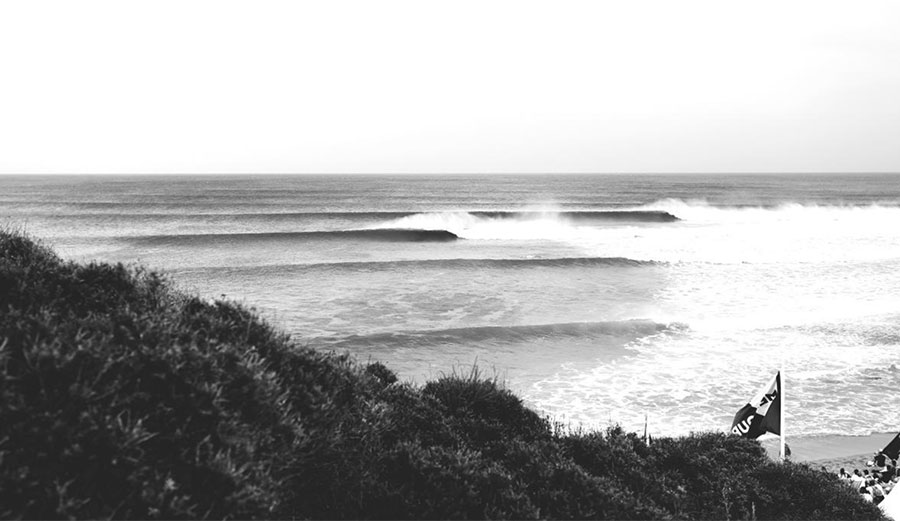
Bells Beach: the oldest running event in surf history. Image: WSL

Back in January of 1962, Peter Troy and Vic Tantau kicked a pebble down a hill. They did not expect that the pebble would continue to roll for years to come and become one of the heaviest, most famous rocks in surfing history. That pebble was the inaugural contest at Bells Beach, which, just over a decade later, would become the Rip Curl Pro and eventually, the longest running professional contest.
Surfing, however, is a miniscule speck on what makes the history of Bells Beach so interesting. Thousands of years ago, the local tribe there used it as a gathering place. “The gently sloping limestone reef, which now provides one of the most iconic platforms in professional surfing,” wrote Ben Mondy for the WSL, “then provided a consistent food source with low tide supplying a buffet of abalone and crayfish. Then, as now, it was a special part of the Australian coastline that drew ocean-minded people to its rocky shores.”
In the mid-1800s, John Calvert Bell put down roots on a piece of property in the area. Called a pastoral run, it was similar to homesteading where a settler occupies a section of government-owned land with no actual legal rights to it, then starts a farm. Governors in the area were given the authority from the Crown to give free settlers and former convicts tracts of land in exchange for land cultivation. Bells Beach was named for him.
Troy and Tantau were co-founders of the Bells Beach Boardriders Club, and that first event, as one would assume, wasn’t much more than a few friends and a couple of cheap trinkets for trophies. “Peter and I put the word out that we would be holding a competition at Bells the first weekend the waves were nice and big,” Tantue explained on the Encyclopedia of Surfing. “Then we just set up a card table on the beach and judged the whole thing ourselves.”
By today’s standards, the wave at Bells isn’t exactly high performance. Barrels are rare, and although the wave does hold a lot of power, it’s a long, sloping wave that is frequently hampered by weather issues. Still, though, because of the history there and the wave itself, it’s one of the surfing’s most celebrated places. Ringing the bell is one of competitive surfing’s greatest achievements. When Kelly Slater won his third Rip Curl Pro, he said that “the Bell is arguably the best trophy you can win in surfing.” And only the winners are allowed to ring it, a stipulation straight from Joe Sweeney, the man who built both the iconic trophy and the first real road into the beach.
Winners include a laundry list of surfing greats such as Tom Carroll, Tom Curren, Simon Anderson, Nat Young, Michael Peterson, Margo Oberg, Martin Potter, Lisa Anderson, Kelly Slater, Layne Beachley, Sunny Garcia, Stephanie Gilmore, Mark Occhilupo, Layne Beachley, Shane Dorian, Andy Irons, Adriano de Souza, Carissa Moore, and of course, Mick Fanning. Fanning has announced that the 2018 Bells event will be his last contest as a professional surfer.
People have been surfing Bells since the ’40s. According to EOS, Vic Tantau and Owen Yatemaan were the first ever to paddle out, but it wasn’t until years later when boards got a little lighter than Bells began to truly be well-known. In 1966, Bells had a role in The Endless Summer.
It was 1973 when Rip Curl wetsuits, just four years old at the time, signed on to sponsor the event. There was $2,500 in the prize purse, with $1,000 of it going to the winner. Michael Peterson laid claim to the first win there, and just a few years later, when the women’s division got a chunk of the pie (an unreasonably small one), Gail Couper won. Over the next twelve years, Couper would win ten times there. When Bells was officially inducted as part of the world tour circuit three years later, Jeff Hakman declared victory and became the first person from outside of Australia to win.
Bells was a favorite of many of the old heroes—Midget Farrelly, Nat Young, Bob McTavish, Wayne Lynch, and many others in surfing’s lore held a spot for it in their hearts. It even played a role in the evolution of the surfboard—the Bells event in 1981 was where Simon Anderson revealed his new fin setup, the thruster. That famous heat in 1986 between Occy and Tom Curren is widely regarded as one of the greatest heats ever. So while Bells might not be the best wave on the tour, the history there gives it a hallowed place in surfing’s halls.

