
Photo: Gerald Schömbs//Unsplash

Despite what you might’ve heard, for three straight years, the number of sharks attacks worldwide was on the decline. In 2021, however, they picked back up to the global five-year average. Still, though, the global average over a longer time period is declining. According to the Florida Museum of Natural History’s International Shark Attack File (ISAF), in 2021 there was a total of 73 unprovoked incidents, 39 provoked shark bites, and nine fatalities.
Surfers, as you might suspect, made up the majority of the victims. Since people who ride waves spend more time in the water and more time in surf zones where sharks have been known to hunt, they made up 51 percent of all attacks worldwide.
Interestingly, 2020 saw a steep drop in shark attacks. While it’s not exactly clear why that was, it’s likely that global beach closures and lockdowns saw less people in the water. “Shark bites dropped drastically in 2020 due to the pandemic,” said ISAF manager Tyler Bowling. “This past year was much more typical, with average bite numbers from an assortment of species and fatalities from white sharks, bull sharks, and tiger sharks.”
“Unprovoked incidents” are defined as, “incidents which occurred in the shark’s natural habitat without human provocation,” and are the most helpful to researchers attempting to understand sharks’ natural behavior. That understanding helps in figuring what, if any, mitigation measures should be taken.
According to ISAF’s data, the United States leads the way in the annual number of shark bites. Most of them (all but five out of 47) took place along the East Coast. In all, the U.S. accounted for 64 percent of shark bites in 2021. Australia was second, with 12 total bites. It has a global five-year average of 16 bites. Although Australia has fewer bites, they had more fatal ones. Three people died there as a result of a shark attack in 2021. Brazil and New Zealand both had three bites.
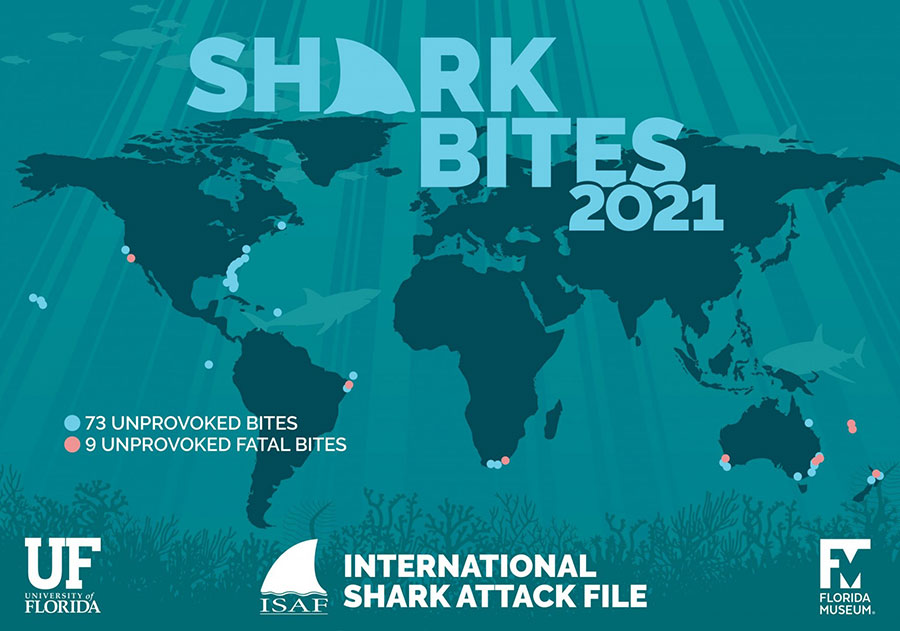
After three years of declining attacks, 2021 saw a jump back to average. Graphic: Jane Dominguez//University of Florida
South Africa, the place where perhaps the world’s most-watched shark attack occurred, reported a grand total of zero incidents in 2020, but in 2021 there were three. One was fatal. For a place that’s become synonymous with shark attacks, 2020’s numbers may seem surprising. But in 2017, a pod of killer whales moved into the waters off of Cape Town, leading researchers to believe that the whales forced the great whites to make themselves scarce.
“We don’t know how often orcas kill white sharks, but when they do, they seem to have a preference for the oily liver and leave the rest,” Bowling explained. “As of 2021, however, white sharks appear to have migrated east, and more are now seen along South Africa’s Wild Coast.”
Although it might seem alarming to learn that shark attacks are indeed on the increase, when taken in sum with the lower numbers from the previous years, 2021’s incidents are in line with long-term average. “As more people have flocked to warm beaches, encounters with sharks have become more common, especially in Florida, which has the second-highest rate of population growth in the United States,” the ISAF report reads. “Yet deaths, in the long run, are becoming less frequent.”
Gavin Naylor, the director of the Florida Museum’s shark research program, believes that the global decrease in shark-related fatalities can be attributed to a few things. “The overall decline in mortalities from shark bites is likely due to a combination of improved beach safety protocols around the world and a diminishment in the number of sharks of various species in coastal waters,” he explained. “The spike in 2020 and 2021 is almost certainly because of the expanding numbers of white sharks, which have been increasing in various localities likely in response to a boom in the seal populations they feed on.”

