
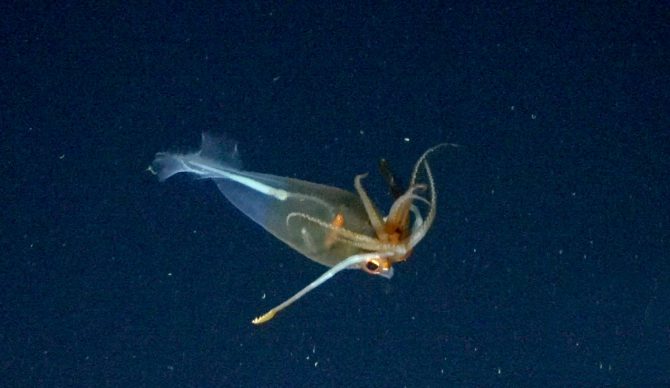
The first confirmed footage of the G. glacialis was filmed in the Bellingshausen Sea near Antarctica during the Schmidt Ocean Institute’s January expedition, which examined the seafloor after an iceberg the size of Chicago calved from the George VI ice shelf. Photo: Schmidt Ocean Institute

In January, the Schmidt Ocean Institute was on a research expedition in the Bellingshausen Sea near Antarctica. It was a once-in-a-lifetime trip, because a massive slab of an iceberg had just calved off the George VI ice shelf and it was the first time scientists were able to have a look at what goes on down there in the hours and days after a calving event of that size. While they found many interesting things floating around down there, a few stood out. The one that stood out the most was the first-ever footage of an exceedingly rare creature called the Galiteuthis glacialis, a glacial glass squid to the layperson.
The expedition, which took place over 35 days, had deep-sea expert named Dr. Thom Linley from the Museum of New Zealand Te Papa Tongarewa along for the ride. As he was poring over the feed from the ROV making its way along the never-before-seen piece of seafloor, he spotted the glacial glass squid. At 2,254 feet deep, he was sure that he was the watching the first footage of a live specimen ever.
“In the footage,” a press release reads, “the transparent G. glacialis positions its arms loosely above its head, similar to the cockatoo pose commonly observed in other glass squids… G. glacialis is a glass squid species that has never been seen alive in its natural environment before.”
Amazingly, the glacial glass squid wasn’t the only first-ever footage the researchers managed to catch. They also filmed the very first footage of a colossal squid. It’s a testament to just how much there is to learn about our planet.
“The first sighting of two different squids on back-to-back expeditions is remarkable and shows how little we have seen of the magnificent inhabitants of the Southern Ocean,” said Schmidt Ocean Institute’s executive director, Dr. Jyotika Virmani. “Fortunately, we caught enough high-resolution imagery of these creatures to allow the global experts, who were not on the vessel, to identify both species.”

