
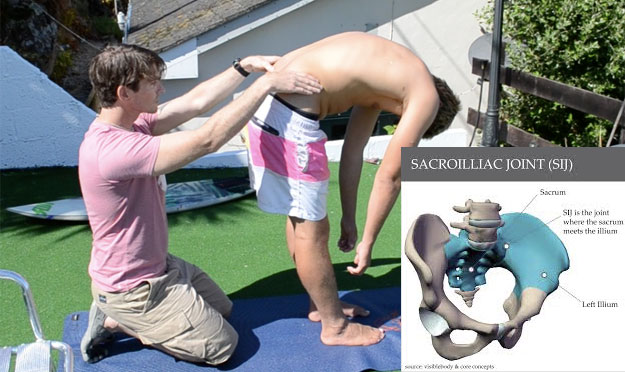
For all intents and purposes, the Sacroiliac Joint (SIJ) is an extension of your spine that runs from the bottom of the lumbar spine to your acetabulum–where your femur connects to the pelvis. It describes the bony and connective tissue structures of the tailbone (sacrum) and the two halves of the pelvis. It works in much the same function as all other spinal segments, because it is a synovial joint, except for the limited range of motion imposed by the tight fit of the tailbone into the bony ridges of the pelvis.
So why do you need to understand this joint? I spend more time in the studio correcting my clients SIJ disorders than anything else. SIJ dysfunction can create pain, discomfort and instability in many places you hold dear.
You know you have this if:
- You have a constant dull ache across the top of the hips (sometimes on one side but not always).
- Occasional spasms in the glutes or low back muscles, especially after bending or single leg loading (e.g. duck diving).
- A tight, sticky feeling in the side or front of the hip that you feel you need to click into place.
- It can also be mistaken for ovarian pain (for blokes, a tight pain just across from the belly button).
The SIJ is a super complicated topic and many leading experts on the subject contradict each other as to how and why it does what it does. So there is an element of educated trial and error that comes with establishing an effective long term treatment plan that works for each person. After all, the truth is what works, right?
There are a few things in particular that create SIJ dysfunction. Sudden impact loading – wiping out, taking a fall, being tackled on one side of the hip. This will often compress that side, and make the other too mobile. Postural imbalances – throwing one hip out when you stand (lots of new mums do this with bub resting on one hip), atlas (upper neck) subluxations like whiplash injuries. There are movement imbalances – single leg (asymmetrical) loading – think of surfing as a prime candidate, where the same leg constantly leads. And finally, just the simple act of being a girl can cause dysfunction in your SIJ joint. During the late phase of the menstrual cycle, girls release loads of hormones (one of which is called relaxin) and can make the joints inherently less stable. Girls, this would not be a good time to do anything gnarly!
Lets ask the important question: What does it do? The pelvis, core musculature and spine are the drivers of all movement. The SIJ and pelvis are the platforms through which you are able to squat, lunge and walk on two legs. They help to link the upper body and core to the hips and legs.
Every time your heel strikes the ground, an energy pulse goes through the muscles and ligaments of your foot and leg, upwards into your pelvis and lower spine (linked by the SIJ). This energy pulse is stored in these connective systems and used to pull you into the next step. Why do you think you swing your arms when you run? It is rotation that winds up the connective tissues in your body to spring you forward. This is why it’s so much harder to run in soft sand. Your timing mechanism gets thrown off forcing you to overuse your muscles.
Your body has to compensate when this key linking system becomes funky. This often means that one side of the pelvis is twisted forward relative to the other side, leading to muscle and ligament imbalances in the supporting structures and overuse injuries.
It can also lead to hypermobility in the lumbar spine (leading potentially to disc injuries/complications) and across the hip. When the hip becomes unstable, you will find you are more likely to roll over your ankle or overly pronate your foot (giving you one flat foot). Any of these can lead to seemingly unrelated injuries like knee pain, toe pain, foot pain and tight hip flexors or hamstrings that just wont release despite regular stretching.
So what can you do about it? Read on.

