
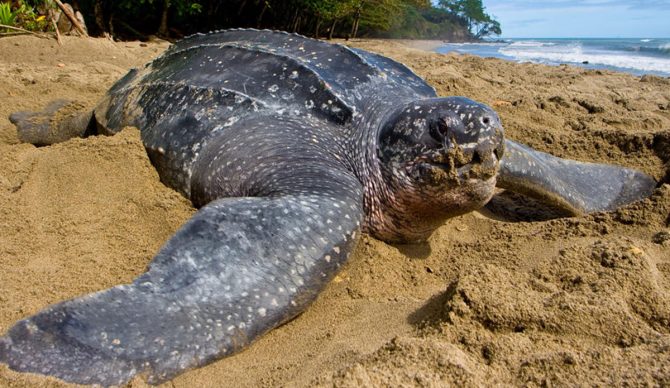
A leatherback turtle on the shores of Trinidad. Photo: Brian Hutchinson//Oceanic Society

A new study from the International Union for Conservation of Nature (IUCN) looking at sea turtle populations around the world found something surprising: they’re on the rise.
The IUCN is the organization that created the Red List, which looks at population numbers of flora and fauna around the globe. It looked at nearly 50 different populations of six different species of sea turtles, taking into account the health of their habitats, threats, and a few other things, and found that the decades of conservation efforts are having an effect. Not a striking one, but an effect nonetheless.
It’s useful to know something about humans. Despite our best intentions (some of our best intentions, anyway), we’re decidedly bad for most of the other animals we share the planet with. Since we began our creeping spread across the planet, we’ve left a trail of devastation in our wake. A vast number of animals have gone extinct as a direct result of humans’ insatiable need for growth. The animals that are doing the best — if by “best” we’re talking about population numbers — are animals that we use, like chickens and cows.
“If things continue at the present pace, it is unlikely that whales, sharks, tuna, and dolphins will follow the diprotodons, ground sloths, and mammoths to oblivion,” wrote Yuval Noah Harari in Sapiens: a Brief History of Mankind. “Among the world’s large creatures, the only survivors of the human flood will be humans themselves, and the farmyard animals that serve as galley slaves in Noah’s Ark.”
Marine turtles were doing wonderfully before we arrived. They were here while the dinosaurs walked the Earth. They beat the Cretaceous-Paleogene extinction, an event that killed 76 percent of everything on Earth. But humans? we’re doing a fantastic job of making life nearly impossible for an animal that has proven itself to be extraordinarily hardy.
“Threats to turtles are numerous, but the greatest risk to their survival is us,” the Natural History Museum (NHM) London writes. “Among the issues are entanglement in fishing gear and other trash we leave in the ocean. They also accidentally consume plastics and juveniles can get plastic rings caught around them that deform their shells as they grow. Boats collide with them, oil spills lead to health problems and they live in an environment we have filled with pollution.”
Add all those things to the fact that they’re eaten fairly regularly, used as medicine, and are killed for their shells. Plus our warming oceans are doing something weird to the ratio of males to females, and our city lights make them go away from the water when they hatch instead of toward it. With all that piling up, you can only come to one conclusion: humans are terrible for sea turtles.
We’ve known that for a long time now, and a select few groups have been working diligently to keep sea turtles from going the way of the dodo. The IUCN’s study sure makes it seem as though all that work is making a dent.
“This work demonstrates the profound impact of local conservation efforts around the world,” said Bryan Wallace, lead author of the study. “It reflects the dedication of countless individuals and organizations who have worked on the ground and in the water to protect these ancient and iconic mariners.”
In short, the study found that the many threats sea turtles face are dwindling and the population levels are rising. The authors also created an interactive dashboard to help the reader better understand their findings.
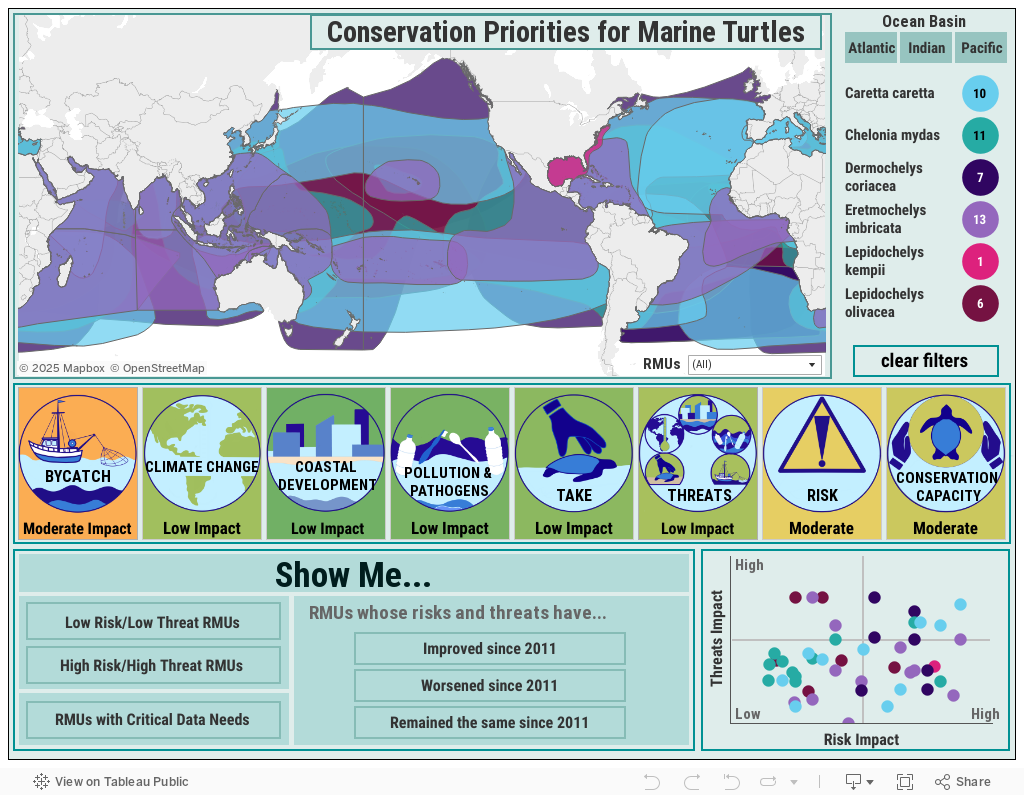
But sea turtles of all kinds — most notably the leatherback — are still in dire straits. Every group, in fact, is still deemed “high risk.” Populations of leatherbacks are still declining overall, despite the slight uptick in other species.
“Overall, this is excellent news that decades of sea turtle conservation has paid off,” said Roderic Mast, co-chair of the Marine Turtle Specialist Group and president of Oceanic Society. “But, at the same time, it is a call to action and a reminder that we must keep up the work we have been doing, and redouble our efforts for the most threatened populations.”

