
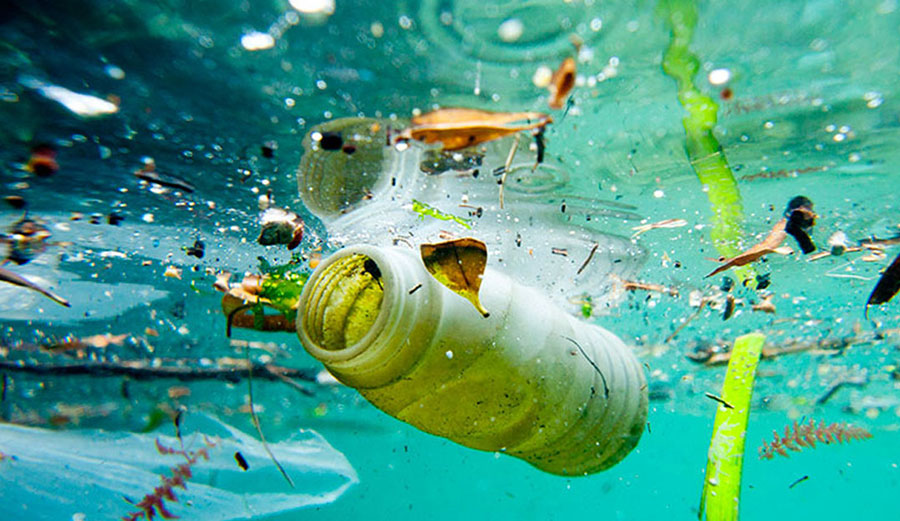
If one theory is correct, microbes may be evolving to clean up our mess. Photo: Elite Reader

By now, you’re probably aware of the gigantic pile of garbage that’s floating around out there. Between garbage patches, Indonesia, sad pictures of dead birds, whales full of trash, and Boyan Slat, you’d be hard-pressed to claim ignorance. That shit is everywhere, and we’re floating around in it. But here’s something odd: despite the fact that there is an unfathomable amount of plastic in the ocean….there should be way more of it. Researchers suspect that might be because–and this is true, I swear–some kind of creature is evolving to break it down.
Although we’re making more and more plastic every day (and, of course, dumping vast amounts of it into the ocean), surveys aren’t showing it. According to New Scientist and a study published in New Frontiers in Ecology and the Environment, there’s “only a tenth to a hundredth as much plastic as expected – and the amount of floating plastic does not appear to be increasing.”
Weird, right?
Ricard Sole, a guy who studies stuff like this at the Universitat Pompeu Fabra in Barcelona has a theory about it. Since his team can’t explain with math where the plastic might be going, he thinks that there’s been a boom in a microbe that has developed the ability to biodegrade plastic. Because there are actually colonies of microbes living around floating plastics that differ greatly from other microbes in the ocean, some scientists have tentatively begun thinking of it as a new ecosystem of sorts. They’ve dubbed it the “plastisphere.”
Seems pretty far-fetched to me, but I’m no researcher. I’m not the only one, though–other researchers believe there are far more likely explanations than a plastic-eating microbe.
It is perplexing, though. Where does all the plastic go? “It has been 40 years since the first scientific reports of plastic pollution in the ocean, but we still have plenty to learn,” wrote Colin Barras in 2015. “For instance, the combined results from 24 oceanic expeditions published late last year concluded there may be perhaps 244,000 tonnes of floating plastic out there. This is puzzling because conservative estimates suggest something like 9 million tonnes of plastic have entered the oceans since the 1970s.”
The most obvious destination for all that disappearing plastic–to me, anyway–is that it’s either sinking into the impenetrable depths or breaking down into tiny pieces that are being consumed by animals. That’s a sentiment shared by Linda Amaral-Zettler of the Netherlands Institute for Sea Research, who, incidentally, also came up with the term “plastisphere.”
Keep in mind that Sole is just hypothesizing. As he has yet to prove that microbes have evolved to eat plastic, he’s aware that the plastic could be merely sinking. His study only proved that there was less plastic in the ocean than there should be–it didn’t find what was happening to it.
If there’s one thing every agrees on, though, it’s this: plastic shouldn’t be in the ocean, and the best course of action is simply to stop putting it in there.

